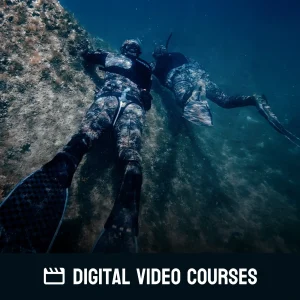
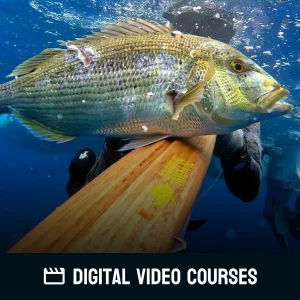
For Europeans, spearfishing is a relatively young pursuit. In Japan it has long traditions. Early hunters used a long bamboo pole with barbed prongs and a hand grip wrapped with line. The diver would spot a fish, surge forward, strike with the prongs, then recover the catch by pulling the line while surfacing to reset for the next dive. Boats often accompanied these hunters, and some divers were famed for staying underwater for more than three minutes.
Arrival in Europe and rapid evolution
Spearfishing took root along the French coast and then spread across the Mediterranean. Europeans soon refined the hunting tool into the modern speargun. Early designs used a tubular body, a handle, and a shoulder butt, with energy stored in a spring inside the tube that launched a steel shaft.
What stayed and what changed
Across the last century many propulsion systems appeared. Some were spring powered, rubber band powered, pneumatic, even powder based and electric concepts. Today the widely accepted choices are rubber band guns and pneumatic guns. They are reliable, accurate in trained hands, and supported by clear safety standards and local regulations. Historical powder based devices belong in museums and should not be used.
Two barrel models exist as well. They allow a second shot if the first does not connect, yet most beginners and many experts prefer a single barrel for simplicity, balance, and quiet operation. Whichever design you use, attach a line to the shaft and manage it with a simple reel so you can recover the shaft and control larger fish.
Simple tools you may encounter
Alongside spearguns there are simpler devices such as pole spears and slings. A pole spear is a straight shaft with a point at one end and elastic at the other. It demands closer range and precise approach, which helps new hunters learn stealth. A sling is a forked handle with elastic that launches a shaft. It occupies both hands and is less convenient in rough water, so beginners usually start with a speargun or a pole spear.
Basic equipment checklist
- Mask with clear field of view
- Snorkel for relaxed surface breathing
- Fins that fit well and track straight
- Knife for safety and line cutting
- Stringer or small float with a fish keeper line
- Gloves for grip and loading comfort
- Optional small float with line or a compact reel for shaft retrieval
Choosing a spot and the right time
Start on rocky or mixed bottom where visibility is better and fish have structure to move around. Avoid crowded swimming areas. Mornings and late afternoons are often productive. Always dive with a partner and agree on simple signals and a rotation. In warm water you can stay longer yet still plan regular rests on shore.
Entry and surface protocol
Enter the water calmly. Put fins on in shallow water where you can sit and balance. Load your speargun only when you are ready to hunt and always point it safely away from people. On the surface move slowly, keep your profile low, and let your fins do quiet work. Sudden movements spook fish and burn energy.
The first descent
When you spot a fish, gather your legs, let your head tip forward, and allow body weight to start the drop. Then add gentle fin strokes and minimal hand motion. Your goal is a smooth, silent glide that keeps the fish calm.
Closing the distance
Do fish fear people or are they curious The answer is both. Many hover between caution and curiosity. The best approach is to remain unnoticed or appear unthreatening. Use the terrain. Wait behind a rock and let the fish drift into view. Side shots are highest percentage because the target profile is largest. When a fish approaches head on, prepare but hold the shot. As soon as it offers a slight angle, that is your moment. Shots from behind are rarely worth it unless you are facing a moving school where a zigzag path can still bring a clean side angle.
After the shot
A hit does not always equal a landed fish. Keep tension on the line without jerking the shaft free. Guide the fish away from rocks that could wedge the shaft. When you reach the surface, secure the catch on your stringer or float, reset your gear, and rebuild calm breathing before the next dive. Make select shots only. Ethical hunting means taking clean opportunities and avoiding waste.
How fish see you
From below, fish see a bright circular window of surface above them. Outside that window light reflects, much like a mirror. Many species rely on one eye at a time for scanning, which makes depth judgment imprecise. Approach from the side using cover and slow movements. If you must cross open water, move at a constant gentle pace and do not stare directly at the fish until you are within comfortable range.
What to target
Most spearfishing focuses on coastal species. Pelagic speedsters such as tuna or bonito are special encounters and not a beginner objective. Learn the habits and seasons of your local reef fish. Keep a log of locations, time of day, current, wind, and behavior. Even failed sessions teach valuable lessons and fill the gaps in your understanding.
Culture, clubs, and ethics
Spearfishing communities thrive on shared knowledge. Clubs and groups exchange tips, set standards, and organize events. They help reinforce selective harvest and respect for local laws. History shows that over crowded coasts lose larger fish first, which is exactly why modern spearfishers focus on restraint, selectivity, and safety.
Safety above everything
Always dive with a partner. Use a visible float where required. Know the local rules for size and season. Keep your equipment in top condition. Take a freediving course to learn rescue basics and blackout prevention. The real goal is peace and presence under the surface. The fish you bring home is a bonus.