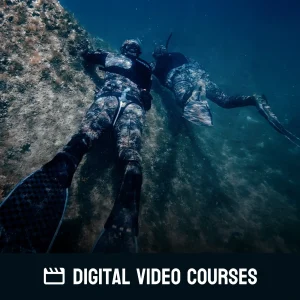
Freediving, also known as breath-hold diving or apnea diving, is a form of diving in which a diver holds their breath after inhaling on the surface and swims underwater for a certain distance or duration. This way of diving has been known for as long as humanity itself. According to one evolutionary theory, humans may have developed in the water and emerged from it out of necessity – driven by the search for food, or perhaps by curiosity and desire for a different kind of nourishment, like Eve’s apple.
One of the most famous spearfishers, the American Terry Maas, who holds several world records for the heaviest fish ever caught with a speargun, described a freediver in his book Blue Water Hunting and Freediving as the modern counterpart of the Native American hunter — someone who uses a bow, arrow, or spear to hunt animals on land, just as a spearfisher hunts fish underwater with a speargun.
The oceans — the world’s seas — are the wildest places on Earth, where whales sing and dolphins whistle.
Almost everyone has, at some point, taken the opportunity to put on a mask and peek below the surface. More and more of us are now spending much of our holidays and free time this way. What else is there to do at the seaside? Lie on the beach, sunbathe, play cards, drink in the nearest bar — for some, a pleasure, but for others, sheer boredom and a waste of time. Instead, we put on a mask, swim out, dive down, and take a closer look at underwater plants and animals. In doing so, we discover another world beneath the surface.
Many have tried it, only to give up when faced with difficulties that seemed impossible to overcome. Freediving can indeed be physically demanding. It requires good fitness and self-control, unlike scuba diving, where modern technology has made the experience much easier and turned diving into a pleasant underwater excursion.
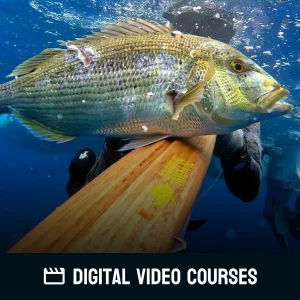
According to both the written and unwritten rules of spearfishing ethics, spearfishing must always be done without any form of underwater breathing aid. Just like fishing from shore, spearfishing is subject to regulations — some unwritten, others set by law (as in Croatia) — which limit the size and weight of the catch. Spearfishing is the only form of fishing where the hunter actually sees and judges the fish before taking it, ensuring that only legal-sized fish are caught. With nets, this is impossible — the mesh determines which fish are trapped. With hooks, it’s the size of the hook that decides which fish can bite. And since each species has a different legal size limit, nets and lines often catch fish that should not be taken.
In Australia, spearfishers have voluntarily agreed not to hunt Napoleon wrasses (large groupers with a distinct hump on the head). They realized these fish are easy prey, beautiful creatures that enrich the underwater world, and too precious to wipe out. Even without an official law, they respect this rule. Unfortunately, in some places, even laws aren’t enough.
According to statistics, spearfishing accounts for less than 1% of the total annual fish catch — far less than hook fishing, and even smaller compared to net fishing.
For that reason, I see no point in debating the supposed damage caused by spearfishers. Like Terry Maas, I believe spearfishing is one of the most noble forms of hunting — where a human enters the fish’s natural environment, unaided by breathing equipment, relying only on skill and instinct.
Freediving and spearfishing take place in repeated intervals of breath-hold dives, typically lasting from 30 seconds to a minute and a half, followed by a return to the surface. Each breath of air, a brief rest, and a moment of focus on where and how to catch the next fish — that’s all the diver needs before the next dive.
If we assume an average surface interval of 45 seconds and an average dive time of 1 minute and 15 seconds, we can calculate that a skilled spearfisher spends about 40 minutes underwater in every hour of diving.
I fully agree with V. Fortič, one of Slovenia’s top spearfishers, who says that spearfishing cannot be learned from books. Experience is more than half of success, which is why the most successful spearfishers are often seasoned athletes between 30 and 50 years old (Mazzari, Emangual, and others). These experiences can hardly be gained from books or articles — they must be earned in the sea itself, often through long conversations about fishing and shared time in the water.
Most people seen snorkeling near beaches or campsites pose no threat to large fish. For them, encounters with bigger species are pure coincidence. They’re more likely to bump into rocks than to spear a prize fish.
A true spearfisher never relies on luck. Every move is careful and deliberate, built on experience and deep knowledge of fish behavior. The diver prepares both body and equipment for that one perfect opportunity — the moment when a big catch appears.
Spearfishers also face real risks. Out in the open sea, they become part of the ocean’s food chain — potential prey for sharks and other predators. While this danger is smaller in the Adriatic than off the coast of Australia, all divers face the same ultimate risk: drowning.
Yet all these risks are balanced by immense rewards. Freedivers return with unforgettable experiences, extraordinary catches, and stories that stay with them forever.